Festive sale season is here. Amazon's Great Indian Festival 2026 opened to everyone on 8 October, and Flipkart's Big Billion Days opens to all on 9 October (About Amazon India, October 2026; Flipkart Stories, 6 October 2026). Both are pushing no-cost EMI, Pay Later and card offers hard.
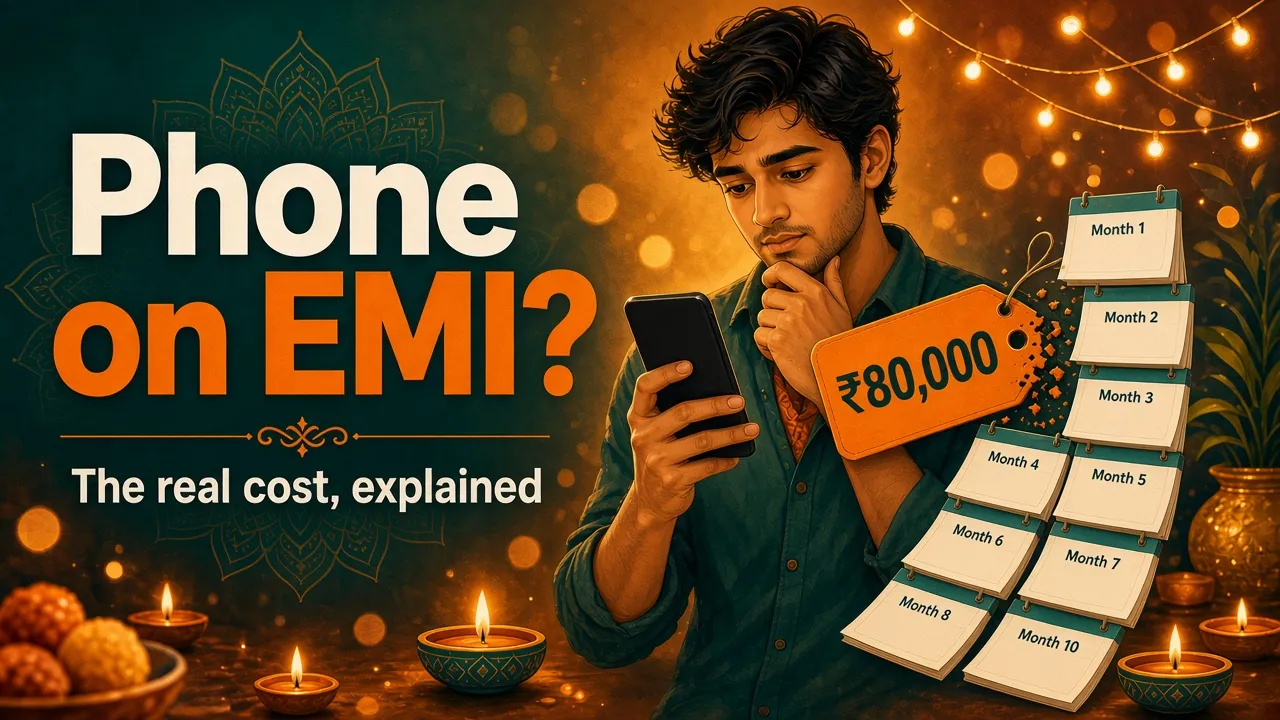
If you're in your twenties and eyeing an ₹80,000 phone you'd never pay for in one go, this guide is for you. No lecture. We'll cover how phone EMIs really work, what they cost (with the maths), how they touch your CIBIL score, and how to work out how much phone you can afford.
Quick answer
- No-cost EMI isn't 0% interest. The bank still charges interest, and the brand covers it with an upfront discount. You still pay 18% GST on that interest plus a processing fee. That's about ₹1,500 extra on an ₹80,000 phone over 12 months in our illustration.
- A regular card EMI costs far more. At 16% a year over 12 months, it's about ₹8,700 extra on the same phone.
- A missed EMI costs more than the interest. You pay late fees, bounce charges and penal interest, and get a mark on your credit report.
- Our guideline: keep the phone EMI under 10% of your take-home pay and the tenure at 12 months or less, and borrow only if you have an emergency fund. If it doesn't fit, buy an older model or save first.
Why everyone around you is buying phones on EMI
- Close to half of phone sales are financed. Counterpoint Research expects NBFC loans and card EMIs to account for 42% of India's smartphone sales in 2026, up from 35% in 2025. One-time full payments still have a slightly larger share (Counterpoint Research, 3 July 2026; The Hindu BusinessLine, 3 July 2026).
- Smaller cities lead. EMIs paid for 57.5% of smartphone purchases in Tier 2 offline retail in April–June 2026, up from 44% a year earlier. Tier 1 was at 41% (Counterpoint data via Business Standard, 11 August 2026).
- Tenures are getting longer. The average financing tenure reached 10 months in Q2 2026. Apple buyers had the longest, at 17.2 months (Counterpoint Research, 10 August 2026; Business Standard, 11 August 2026).
- Premium phones are growing fastest. Phones above ₹30,000 grew 11% in 2025, a record 22% of shipments (Counterpoint via ETTelecom, 2 February 2026).
- Young Indians are borrowing earlier. In March 2026, 50% of first-time credit card holders were 30 or younger. Among Gen Z who got their first card in 2024, 18% already had an open consumer durable loan (TransUnion CIBIL, 8 July 2026).
EMI has become the default way to buy a phone, which is why the fine print matters.
How phone EMIs work in India
1. Regular credit card EMI
You choose EMI at checkout, or convert the purchase after paying. The bank charges interest on a reducing balance, plus 18% GST on the interest in every instalment and a processing fee. For example, HDFC Bank lists merchant EasyEMI rates of 11.56%–21% a year for July–September 2026. It also says EasyEMI purchases don't earn reward points (HDFC Bank EasyEMI page). Converting after purchase ("SmartEMI") averaged 18.03% IRR in January–March 2026, with a processing fee of up to ₹849 + GST (HDFC Bank SmartEMI page).
2. "No-cost" EMI
Amazon's terms explain it plainly. No-cost EMI is "funded by participating sellers and brands", who provide "amounts equivalent to the interest imposed by the banks". Banks may charge GST "over and above the product price" (Amazon.in, Terms & Conditions of EMI). HDFC's terms say the same: the merchant gives a discount equal to the interest, and the "bank continues to charge interest as applicable" (HDFC Bank EasyEMI page).
So you skip the interest itself, but you still pay:
- 18% GST on the interest, and
- a processing fee. On Amazon, HDFC and ICICI credit card EMIs carry ₹299 + GST per transaction. Axis charges ₹599 + GST on transactions of ₹50,000 and above (Amazon.in EMI terms).
What RBI says: In September 2013, RBI told banks that "the very concept of zero percent interest is non-existent". It said such schemes "only serve the purpose of alluring and exploiting the vulnerable customers" (RBI circular RBI/2013-14/292, 17 September 2013). Today's card rules make issuers show you the principal, interest and upfront discount before an EMI conversion and on your statement. An EMI with interest "shall not be camouflaged as zero-interest/no-cost EMI" (RBI Master Direction on Credit and Debit Cards, 21 April 2022, updated 7 March 2024; the same wording appears in RBI's NBFC credit card directions of 28 November 2025). So read that EMI breakdown screen.
3. Debit card EMI
Some banks offer pre-approved EMI on debit cards. It's still a loan, with fees. On Amazon, ICICI charges ₹99 + GST and Kotak ₹199 + GST per debit card EMI (Amazon.in EMI terms).
4. NBFC EMI cards and store finance
This is the "zero down payment" deal at the phone shop. Bajaj Finance's Insta EMI Card has a ₹530 joining fee. Each loan on it can carry a processing fee of up to ₹1,017, "upfront interest" of up to ₹1,017, a ₹600 bounce charge and a 36% a year penal charge on late instalments (Bajaj Finance fees page). About 67% of financed phones are financed by NBFCs, led by Bajaj Finance (Counterpoint via The Hindu BusinessLine, 3 July 2026).
5. Buy Now, Pay Later (BNPL)
Pay Later is a loan from the bank or NBFC behind the app. Amazon Pay Later is lent by Axio and IDFC FIRST Bank. For IDFC customers, the late fee is 3% of the unpaid due plus GST, and Amazon warns that late payment "could result in a negative impact to your CIBIL score" (Amazon.in, Amazon Pay Later Repayments). RBI's digital lending rules require a Key Fact Statement showing the all-in annual cost (APR) before you sign. They also give you a cooling-off period of at least one day to exit without a penalty (RBI, Digital Lending Directions, 8 May 2025).
The real cost: an ₹80,000 phone, worked out
This is an illustrative calculation, not a quote. Your bank, rate and offer will differ. Our assumptions:
- Price: ₹80,000
- Interest rate: 16% a year, our assumption, within HDFC's published 11.56%–21% EasyEMI range
- Processing fee: ₹299 + 18% GST = ₹352.82, the HDFC credit card EMI fee listed on Amazon
- GST: 18% on interest
- We ignore the extra days of interest some banks add to the first EMI
Formulas
- EMI = P × r × (1 + r)^n ÷ [(1 + r)^n − 1], where P is the price, r is the monthly rate (16% ÷ 12) and n is months. This is the formula HDFC Bank publishes with its EMI calculator.
- Total interest = (EMI × n) − P. GST = 18% × total interest.
- No-cost EMI: you pay ₹80,000 ÷ n a month. The discount equals the bank's interest, so you pay only the GST on that interest plus the fee.
| OptionMonthly EMIInterest you payGST on interestFee + GSTTotal paidExtra cost | ||||||
| Pay upfront | — | ₹0 | ₹0 | ₹0 | ₹80,000 | ₹0 |
| No-cost EMI, 6 months | ₹13,333 | ₹0 (₹3,604 covered by discount) | ₹649 | ₹353 | ₹81,002 | ₹1,002 |
| No-cost EMI, 9 months | ₹8,889 | ₹0 (₹5,083 covered) | ₹915 | ₹353 | ₹81,268 | ₹1,268 |
| No-cost EMI, 12 months | ₹6,667 | ₹0 (₹6,523 covered) | ₹1,174 | ₹353 | ₹81,527 | ₹1,527 |
| Card EMI at 16%, 6 months | ₹13,962 | ₹3,775 | ₹679 | ₹353 | ₹84,807 | ₹4,807 |
| Card EMI at 16%, 9 months | ₹9,492 | ₹5,428 | ₹977 | ₹353 | ₹86,757 | ₹6,757 |
| Card EMI at 16%, 12 months | ₹7,258 | ₹7,102 | ₹1,278 | ₹353 | ₹88,733 | ₹8,733 |
Rounded to the nearest rupee. GST is billed on top of the monthly EMI.
What this tells you
- No-cost EMI is cheap, not free. It adds about 1.3%–1.9% here, and a longer tenure means more GST.
- A regular 12-month EMI adds about 11% to the price.
- Watch for a "lost discount". Sometimes the best price is only for full payment. Suppose paying upfront got you ₹4,000 off (a hypothetical): you'd pay ₹76,000, versus ₹81,527 on the 12-month no-cost EMI, a gap of ₹5,527. Always compare the final checkout price for both.
How much phone can you afford?
There's no official rule for this. What follows is our guideline, based on a well-known budgeting idea. The 50/30/20 rule splits take-home pay into 50% needs, 30% wants and 20% savings. It was popularised by Elizabeth Warren and Amelia Warren Tyagi in their 2005 book All Your Worth (Simon & Schuster; Investopedia, updated 2 September 2026). A flagship phone is a want. If one gadget eats your whole "wants" share, there's nothing left for anything else. So:
- Keep the phone EMI at or below 10% of take-home pay, about a third of your "wants" money.
- Keep the tenure to 12 months or less. Longer plans make expensive phones look cheap.
- Keep all your EMIs together at or below 30% of take-home. That's our cushion, not a lender rule.
- Build an emergency fund first: at least one or two months of expenses.
| Monthly take-homeMax phone EMI (10%)Phone budget (12-month no-cost EMI) | ||
| ₹25,000 | ₹2,500 | about ₹30,000 |
| ₹40,000 | ₹4,000 | about ₹48,000 |
| ₹60,000 | ₹6,000 | about ₹72,000 |
| ₹1,00,000 | ₹10,000 | about ₹1,20,000 |
By this guideline, an ₹80,000 phone on a 12-month plan (₹6,667 a month) suits a take-home of about ₹67,000 or more. On ₹35,000 a month, it would eat 19% of your salary for a year.
How phone EMIs affect your CIBIL score
- Applying for credit: Each loan application leads to a hard inquiry, and "multiple inquiries in a short period may impact your score" (TransUnion CIBIL brochure, September 2025). Don't open three EMI cards and two Pay Later accounts in one sale.
- Credit utilisation: HDFC blocks your card limit for the full purchase amount and frees it up as you pay the EMIs (HDFC Bank EasyEMI page). An ₹80,000 phone on a ₹1,00,000 limit means 80% utilisation on day one. CIBIL says high utilisation "can negatively impact your score".
- Missed payments: At HDFC, the EMI is part of your Minimum Amount Due. Miss it three months running and the bank closes the EMI and bills the full outstanding amount plus pre-closure charges (HDFC Bank EasyEMI page). Late fees go up to ₹1,300 + GST, and revolving interest on most cards is 3.75% a month, or 45% a year (HDFC Bank Credit Card MITC, September 2026).
- BNPL and EMI cards are reported too. Bajaj Finance's EMI card terms authorise it to share loan data with credit bureaus (Bajaj Finance MITC, via Amazon.in), and Amazon Pay Later warns of bureau impact.
- Phone locking: From 1 January 2027, banks can restrict a phone they financed only after the loan is 30 days overdue and notices have been sent. Full restrictions come only after 60 days. Incoming calls, SMS and SOS must keep working, restrictions must be lifted within an hour of payment, and lenders can't access your personal data (RBI, Commercial Banks – Responsible Business Conduct Fourth Amendment Directions, 6 August 2026).
Hidden traps to check
- Foreclosure charges: HDFC charges pre-closure interest plus 3% of the outstanding principal, and takes back the merchant discount or cashback (HDFC Bank EasyEMI page). Kotak lists up to 2% + GST on Amazon merchant EMIs (Amazon.in EMI terms).
- Fees stay even if you return the phone: HDFC doesn't refund the processing fee on cancellation (HDFC Bank EasyEMI page).
- Bounce charges: Bajaj Finance charges ₹600 per bounce plus a 36% a year penal charge (Bajaj Finance fees page). Keep your auto-debit account funded.
- Lost reward points: HDFC EasyEMI purchases earn none (HDFC Bank EasyEMI page).
- Add-ons in the loan: Insurance or extended warranty can get added into the financed amount at the store. Check the charge slip before signing. HDFC says you can ask the merchant to void the transaction if you disagree with the terms (HDFC Bank EasyEMI page).
- Late cashback: HDFC posts brand cashback 90–120 days later, and you lose it if you pre-close or cancel (HDFC Bank EasyEMI page).
- Upgrade programmes: Before signing up, read what you must return, the condition rules, and what happens to the remaining EMIs.
Smarter alternatives
- Save, then buy. Put the would-be EMI into a recurring deposit for 6–10 months and pay upfront.
- Buy an older model. Older generations get the deepest festive cuts. Amazon is advertising an iPhone 16 (128 GB) at ₹74,999 in this sale (About Amazon India, October 2026).
- Go certified refurbished, with a seller warranty and a proper invoice. Check battery health and the return terms.
- Use an exchange offer to cut the amount you need to finance.
- Pick the shortest no-cost tenure you can afford. As the table shows, 6 months costs less than 12.
60-second checklist before you tap "Pay on EMI"
- Is the EMI within 10% of my take-home, and all my EMIs within 30%?
- Do I have an emergency fund?
- Have I compared the final price for full payment against EMI?
- Can I see the processing fee, GST and foreclosure terms on the EMI breakdown or Key Fact Statement?
- Is any insurance or warranty added into the loan?
- Is my auto-debit account funded before every due date?
FAQ
Is no-cost EMI really free?
No. The bank charges interest and the brand offsets it with a discount, but you still pay 18% GST on that interest and a processing fee. RBI said in 2013 that "the very concept of zero percent interest is non-existent" (RBI, 17 September 2013).
Does phone EMI affect my CIBIL score?
Yes. On-time EMIs build your history. Missed EMIs, high card utilisation and lots of credit applications in a short time can lower your score (TransUnion CIBIL brochure, September 2025).
Should I buy an iPhone on EMI?
Only if the EMI is within about 10% of your take-home, the tenure is 12 months or less, the offer is genuinely no-cost, and you have an emergency fund. If the numbers only work on an 18–24-month plan, the phone is probably beyond your budget right now.
Is there GST on no-cost EMI?
Yes. 18% GST applies to the interest component, even when a discount covers the interest, and to the processing fee (HDFC Bank EasyEMI page; Amazon.in EMI terms).
Can I close a phone EMI early?
Usually, yes, but charges may apply. HDFC charges pre-closure interest plus 3% of the outstanding principal (HDFC Bank EasyEMI page). Digital loans come with a cooling-off period of at least one day (RBI, 8 May 2025).
What happens if I miss a phone EMI?
You'll face late or bounce charges, penal interest and a negative mark on your credit report. From 1 January 2027, a bank that financed your phone can restrict it only after 30 days overdue and proper notice (RBI, 6 August 2026).
The bottom line
A genuine no-cost EMI on a phone you can comfortably afford is fine. The trouble starts when the monthly number picks your phone instead of your income. Set your budget first and check the full breakdown. If the EMI doesn't fit, wait or buy a little older.
Disclosure: This is general information, not financial advice. Rates, fees and offers change often, so check your lender's current terms and Key Fact Statement before you borrow. SR Infobiz has no tie-up or commercial relationship with any bank, lender, marketplace or phone brand mentioned here. We didn't run tests or get quotes ourselves. Every figure comes from the named sources, and the ₹80,000 example is our own illustrative calculation.
Sources
All sources accessed 8 October 2026.
- Reserve Bank of India, "Pernicious practices of select banks deterring customer protection and accounting integrity", RBI/2013-14/292, 17 September 2013. https://www.rbi.org.in/scripts/NotificationUser.aspx?Id=8461&Mode=0
- Reserve Bank of India, Master Direction – Credit Card and Debit Card – Issuance and Conduct Directions, 2022 (21 April 2022, updated 7 March 2024). https://www.rbi.org.in/scripts/FS_Notification.aspx?Id=12300
- Reserve Bank of India, Reserve Bank of India (Non-Banking Financial Companies – Credit Cards: Issuance and Conduct) Directions, 2025, 28 November 2025. https://www.rbi.org.in/Scripts/BS_ViewMasDirections.aspx?id=12956
- Reserve Bank of India, Reserve Bank of India (Digital Lending) Directions, 2025, 8 May 2025. https://www.rbi.org.in/scripts/NotificationUser.aspx?Id=12848&Mode=0
- Reserve Bank of India, Reserve Bank of India (Commercial Banks – Responsible Business Conduct) Fourth Amendment Directions, 2026, 6 August 2026 (effective 1 January 2027). https://www.rbi.org.in/scripts/NotificationUser.aspx?Id=13665
- HDFC Bank, "EasyEMI on Credit Card" (rates for 1 July–30 September 2026, GST, terms). https://www.hdfc.bank.in/easyemi/credit-card
- HDFC Bank, "SmartEMI" (rates for 1 January–31 March 2026, processing fee). https://www.hdfc.bank.in/smartemi
- HDFC Bank, SmartEMI Calculator (EMI formula). https://www.hdfc.bank.in/smartemi/calculator
- HDFC Bank, Credit Card Most Important Terms & Conditions, Version 4.12, September 2026. https://www.hdfc.bank.in/content/dam/hdfcbankpws/in/en/personal-banking/discover-products/cards/credit-cards/personal-mitc/mitc-in-english.pdf
- Amazon.in, "Terms & Conditions of EMI". https://www.amazon.in/gp/help/customer/display.html?nodeId=202054440
- Amazon.in, "Amazon Pay Later Repayments". https://www.amazon.in/gp/help/customer/display.html?nodeId=TPsdHKyWfsSfQI0NPq
- Bajaj Finance, "Fees and Charges" (EMI Network Card / Insta EMI Card section). https://www.bajajfinserv.in/all-fees-and-charges
- Bajaj Finance, "Insta EMI Card Fees and Charges". https://www.bajajfinserv.in/insta-emi-card-fees-and-charges
- Counterpoint Research, "Rising Prices to Push Financing to 42% of India's Smartphone Sales in 2026; Samsung Leads", 3 July 2026. https://counterpointresearch.com/en/insights/rising-prices-to-push-financing-to-42-percent-of-indias-smartphone-sales-in-2026
- Vallari Sanzgiri, "EMI and instalment-based smartphone purchases nearly at par with one-time payments in India", The Hindu BusinessLine, 3 July 2026. https://www.thehindubusinessline.com/info-tech/emi-and-instalment-based-smartphone-purchases-nearly-at-par-with-one-time-payments-in-india/article71179771.ece
- Counterpoint Research, "Average Smartphone Financing Tenure Reaches 10 Months in Q2 2026; Tier 2 Markets Leads with 57% Financing Penetration in Mainline channels", 10 August 2026. https://counterpointresearch.com/en/insights/average-smartphone-financing-tenure-reaches-10-months-in-q2-2026
- Harsh Shivam, "Smartphone EMI Use Crosses 50% in Tier 2 Cities: Counterpoint", Business Standard, 11 August 2026. https://www.business-standard.com/technology/tech-news/smartphone-emi-tier-2-cities-financing-penetration-q2-2026-126081101151_1.html
- Ashutosh Kumar, "India smartphone market surges 8% on-year by value in 2025, led by Apple, Samsung: Counterpoint", ETTelecom, 2 February 2026. https://telecom.economictimes.indiatimes.com/news/devices/indias-smartphone-market-grows-8-in-value-driven-by-premium-devices-from-apple-and-samsung/127857324
- TransUnion CIBIL, "Half of India's New-To-Credit Card Consumers are Gen Z and Reside Beyond Metros", 8 July 2026. https://newsroom.transunioncibil.com/half-of-indias-new-to-credit-card-consumers-are-gen-z-and-reside-beyond-metros/
- TransUnion CIBIL, "CIBIL Score & Report" brochure, September 2025. https://www.cibil.com/content/dam/cibil/consumer/cibil-score-and-report-brochure-1-9-25.pdf
- About Amazon India, "Amazon Great Indian Festival 2026 live now", October 2026. https://www.aboutamazon.in/news/retail/amazon-great-indian-festival-2026-deals
- Flipkart Stories, "Flipkart's Big Billion Days Returns for Its 13th Edition on October 9", 6 October 2026. https://stories.flipkart.com/announcement/flipkarts-big-billion-days-returns-for-its-13th-edition
- Simon & Schuster, All Your Worth: The Ultimate Lifetime Money Plan by Elizabeth Warren and Amelia Warren Tyagi (Free Press, 8 March 2005). https://www.simonandschuster.net/books/All-Your-Worth/Elizabeth-Warren/A-Guide-to-Personal-Finances/9780743279741
- Investopedia, "Mastering the 50/30/20 Rule: Balance Needs, Wants, and Savings", updated 2 September 2026. https://www.investopedia.com/ask/answers/022916/what-502030-budget-rule.asp